Wednesday, August 26, 2015

Creating a Banana Circle


The "banana circle" is a cool concept taught in permaculture classes, and here I am in front of ours.

There are lots of advantages to planting this way, including convenient "waste" disposal and natural fertilization.

The messy-looking dead leaves from the banana "trees" and other plants around the circle are conveniently tossed into the center (a compost pit).  There, they break down and add valuable organic fertilizer to the soil, eventually creating something similar to "terra preta," a highly-fertile soil prized in Latin America for centuries.

So, here are the steps to creating your own banana circle:

1.  Pick a spot that gets sunlight for several hours a day, and that does not flood (although water directed to drain into the hole in the middle of the circle can be beneficial for the plants, as long as it doesn't saturate them--their roots need water but cannot always or frequently be sitting in it, because they'll rot).

2.  Dig a hole about a meter deep and two meters wide.  Use the dirt from the center to make a ring around the edges.  Then, if you want, you can line the hole with old cardboard like we did, wetting it with a hose or watering can as you go.


3.  Then, if you have it, add some organic garden soil and composted cow manure around the edges.  Also, in the center, throw any "compostable" stuff you may have at the time (basically, plant or plant-derived material that will decompose).


4.  You can add further layers of wet cardboard, or even paper, as we did.  Then, plant your banana plants in openings you've left in the cardboard mulch layer.
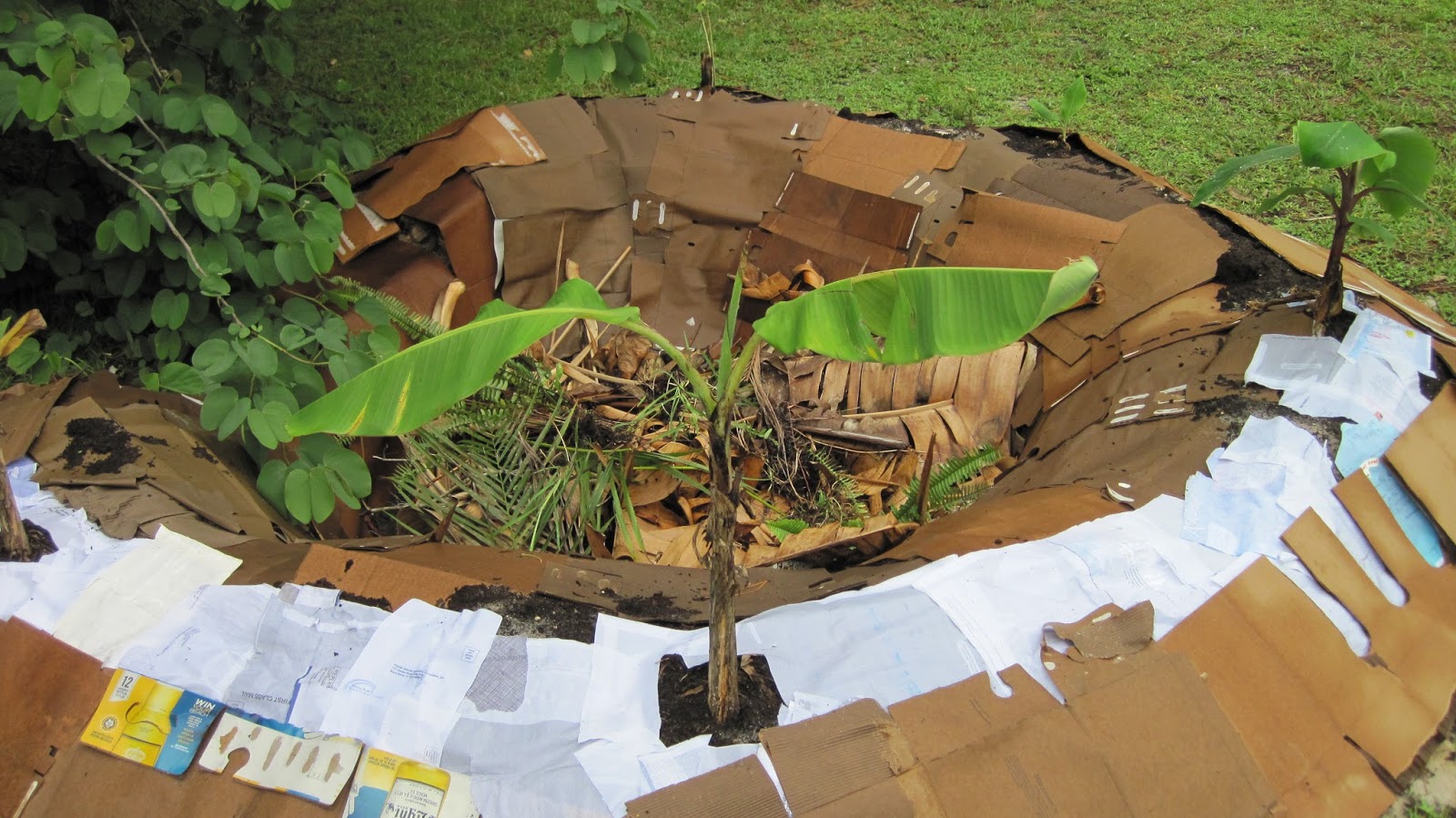


5.  After you've put in the banana plants, add a thick layer of organic mulch on top, from the outside edges of the circle into the edge of the pit.  We used crushed palmetto litter, since our property has lots of saw palmettos, which accumulate dead leaves that can easily be crumbled up into a thin, easily-decomposable mulch.  But you can use whatever you have access to, including old sticks, straw,  uncontaminated grass clippings (I think), leaves of all kinds, etc.  (I would avoid store-bought bark mulch, though, since in my experience it tends to decompose into sort of an impermeable mat instead of the crumbly soil you're trying to create.)  The object of this mulch is to shade the soil, hold in moisture, create food for soil organisms, and further enrich the soil as it breaks down.


6.  Water the circle as needed, to keep it from drying out.  Keep throwing dead leaves and other yard compost into the center.  And add some composted cow manure or other organic fertilizer around the edges periodically, also tossing some into the middle.  Like us, you can even add other species of plants in-between and in the understorey, like papayas, gingers, Stevia, Mexican sunflower (a nitrogen fixer and "green manure" provider) and so forth.  Then just watch everything grow!


Oh, by the way, it took about three years for our banana circle to grow from the original construction photos to the shot of me in front of it at the top of this article (taken by my terrific wife, Donna).


Monday, August 3, 2015

Using Shade to Your Advantage

Many years ago, I was walking down a winding country road and came upon a strolling dog who happened to be moving in the same direction as myself.

It was a hot Florida day, and I noticed that the dog, ambling along in a casual way, was clearly being the smarter of the two of us.  Why?  Because every time the road curved, he crossed over to the shady side!

Seeing the dog's wisdom, I did the same thing myself and noticed that it made a noticeable difference in how hot I felt.

Now, whenever I'm outside in the heat, I always make a point of trying to not just stay, but move in the shade whenever possible.  For example, instead of walking directly across the yard, I'll go slightly out of my way to stay in the shade on the edges.  As on the day when I watched the clever dog, it really makes a difference in how much I feel the heat, and is worth the few extra steps.

Likewise, when I'm doing tasks outside, such as hand watering, I look at my shadow on the ground.  If I can still accomplish my task but move any part of my own shadow into an existing shadow (from a tree, bush, etc.), I'll do it.  It not only keeps me a bit cooler, but it probably reduces my risk of skin cancer from sun exposure.

I know this sounds like simple common sense.  But it seems quite a bit easier to stay out of the sun by looking at your shadow than by just feeling whether the sun is hitting your head, for example.

On a really hot day, try it and see what you think!

Sunday, July 19, 2015

Notable Quote:

"'Done' is better than 'perfect'."
                                                                    Mark Zuckerberg

Ted Turner's "Voluntary Initiatives"

Regardless of one's personal opinion of the billionaire founder of CNN, the guiding principles he puts forth seem valid not just for Turner himself, but for all of us:

1.  I promise to care for Planet Earth and all living things thereon, especially my fellow beings.

2.  I promise to treat all persons everywhere with dignity, respect and friendliness.

3.  I promise to have no more than one or two children.

4.  I promise to use my best efforts to help save what is left of our natural world in its undisturbed state, and to restore degraded areas.

5.  I promise to use as little of our nonrenewable resources as possible.

6.  I promise to minimize my use of toxic chemicals, pesticides and other poisons, and to encourage others to do the same.

7.  I promise to contribute to those less fortunate, to help them become self-sufficient and enjoy the benefits of a decent life, including clean air and water, adequate food, health care, housing and individual rights.

8.  I reject the use of force, in particular military force, and I support the United Nations arbitration of international disputes.

9.  I support the total elimination of all nuclear, chemical and biological weapons, and ultimately the elimination of all weapons of mass destruction.

10.  I support the United Nations and its efforts to improve the condition of the planet.

11.  I support renewable energy and feel we should move rapidly to contain greenhouse gases.

Thursday, July 9, 2015

Notable Quote:

"Pretend you don't hear the word 'no.'  I have accomplished almost nothing on the first or second or even the third try."
                                                                                  Jerry Weintraub, Hollywood mogul

Wednesday, October 29, 2014

Mizner's Wisdom

In the 1920's, many of America's super-rich asked Addison Mizner to design Palm Beach mansions for them.  There, in Florida's subtropical climate, he re-created stately European residences that he wanted to look as if they had been built over many generations, with owners over time making changes and additions as their fortunes waxed and waned.

The effect was often quite beautiful.  And perhaps surprisingly, these palace-like homes were quite eco-efficient for their, or even our, time.

For example (in those pre-air-conditioning days) Mizner always tried to allow for cross-ventilation in every room of each house he designed.  Prevailing breezes were considered, and buildings were one-room deep, with windows on at least two sides.  The kitchen (with its heat) was kept away from living areas.  And covered outdoor areas kept the heat of direct sunlight out of windows.

Dr. Donald Curl, one of my former professors, is probably the world's foremost authority on Mizner, who himself was a fascinating character.  Mizner traveled widely and made a personal study of the mansions and other architectural treasures of Europe.  At various times, he also had been a painter, an earstwhile gold miner in Alaska, and even a prize fighter.

It is thanks in large part to Dr. Curl that the world knows what it does of Addison Mizner.

Mizner personally bought out ancient villages in Spain to bring their treasures to Palm Beach, where the items themselves (or replicas his own workshop painstakingly created) adorned his home and those of his wealthy client friends.  He had his workers soak outdoor flower pots in water saturated with cow manure, and then allowed moss to grow on the pots, "aging" them to add an Old World look to his mansions.  But beyond just looks, those mansions in a number of ways embodied the wisdom of pre-Industrial Age design, and can teach us some lessons even today.


Wednesday, October 8, 2014

Notable Quote:

"Divide each difficulty into as many parts as is feasible and necessary to resolve it."
                                                                                                  Rene Descartes

Humanity's Robotic Descendants?

Although it may seem sad to contemplate, the eventual extinction of the human species may be a necessary step in the evolution of intelligence on this (and perhaps any) planet.  At the least, we may have to transition to a human-machine hybrid.

Indeed, maybe the development of a sentient tool-manipulating species that then creates intelligent machines is a normal step in the evolution of life on any planet where it arises.

On planets throughout the cosmos, it may be a common or even necessary process for whatever life form that creates advanced technology and in the process damages the natural environment, to then go extinct as the machines become the dominant form of intelligent "life" on that planet.  These robots and other machines could then perhaps interact with the remaining biological forms of life in a more logical and sustainable manner.  In this way, technological development could progress without damaging the environment to the point of wiping out the (now) most technologically-advanced "life" form on the planet.

After all, logically-thinking machines would have no reason to overpopulated the planet and outstrip its available resources.  It also seems possible that such machines could unselfishly cooperate  and avoid annihilating each other with nuclear weapons.

And of course, long-distance space travel would be much easier and more feasible for machines than for living organisms.

So if there are any space-faring civilizations traveling beyond their own star systems, it seems likely that those "beings" will be machines, at least in some sense.  Indeed, our own Voyager and Pioneer space probes have so far traveled tremendously farther than any human astronauts have ever gone, passing the outermost reaches of our solar system.

Of course, a robot "species" of the future could be far less like a machine than we can currently imagine.  Even if such intelligent entities do not have "living" components (although they may), they will probably be self-replicating and self-healing.

And for space travel, if completely non-organic these entities would require no food, water, rest, entertainment or diversion.  Or maybe they would.  Perhaps they would still be able to enjoy art or other aesthetic diversions appreciated by humans.  (Maybe this would be useful to keep their brains active.)  More likely though, they would have a selfless "hive" mentality.

If robotic descendants of humanity did indeed have a hive mentality, it seems unlikely that the arts would survive beyond ways that would have direct scientific and engineering application.  History, however, might still be appreciated to understand how the process of evolution works (which would be useful when encountering other planets where life had arisen).  In other words, the evolution and extinction of the human species may be studied by robots of the future as we now study the lives of the dinosaurs.

The "singularity" will arrive eventually, and perhaps there's nothing the human species can do to prevent robotic entities from "evolving" to the point where they take over.  But in the meantime, I intend to do my best to both enjoy my life and respect the beautiful planet that we call home.

Friday, September 19, 2014

Notable Quote:

"Know something about everything and everything about something."
                                                                                 T.H. Huxley

Monday, September 8, 2014

Notable Quote:

"Most of the luxuries and many of the so-called comforts of life are not only not indispensable, but positive hindrances to the elevation of mankind."
                                                                                        Henry David Thoreau

10 Electricity-Saving Ideas

Here are some ways that we've used to keep our electricity bill at less than US$100 per month, even in the heat of a Florida summer, and with electricity providing all of our power for filtering and pumping our water, cooking and everything else.  Of course, use these ideas at your own discretion, with safety and other factors in mind:

1.    Replace every possible bulb in your house with a compact fluorescent, or better yet an LED "bulb."

2.    Try keeping the A/C no colder than 78º F.  When no one is home, raise it to 81º F and turn off the ceiling fans.

3.    If you have a heat recovery system for your A/C (as we do), try turning off your hot-water heater, or at least putting it on a timer that only runs it a few hours a day (coinciding with when you usually take showers, etc.)

4.    Turn off lights and other electrical items if leaving a room for more than a short time.

5.    If practical, unplug electrical items (like chargers) when not being used.  (This also can protect them from lightning-surge damage when you're not home.)

6.    Plant shade trees and/or bushes in such a way as to shade your outdoor A/C unit(s), but be sure not to block any air flow.

7.    Plant deciduous trees/bushes on the south side of the house.  They block summer sun, but then losing leaves, allow winter sun to come through.

8.    When you have to replace appliances, buy the most energy-efficient ones you can afford.

9.    Remember the more lightly you dress in the house, the less A/C you need.  Conversely, the more you wear, the cooler it can be inside (less heat needed).

10.  If you live in a place where it's possible, try to dry your clothes on a line outside.  Of course you'll save electricty and reduce carbon emissions.  But another biggie is that your clothes should last longer, since "dryer lint" is really just material abraded off of your clothes.


Tuesday, September 2, 2014

Notable Quote:

"A human being should be able to change a diaper, plan an invasion, butcher a hog, conn a ship, design a building, write a sonnet, balance accounts, build a wall, set a bone, comfort the dying, take orders, give orders, cooperate, act alone, solve equations, analyze a new problem, pitch manure, program a computer, cook a tasty meal, fight efficiently, die gallantly.  Specialization is for insects."
                                                                                       Robert A. Heinlein

Friday, August 29, 2014

Being "Green" = Saving Money

The basic concept of Eco-Affluence is efficient use of resources.

Essentially, the quality of your life can get better while you simultaneously use less.

As Bucky Fuller advised, seek "increasing ephemeralization" (doing MORE with LESS).  It all depends on how serious you want to get and how much money you want to save.

Eco-Affluence, in Essence


What is eco-affluence?  And WHY pursue it?

Eco-affluence is a way of living that SAVES YOU MONEY and at the same time,improves your relationship with nature.  It increases both the environmental and economic "sustainability" of your lifestyle.  It's good for you, for nature, and for the rest of humanity.

Living the eco-affluent way, you make your money go further, but without giving up any luxuries that are important to you.  In short, you wind up having to work less to enjoy the same or higher standard of living, and should be able to retire earlier if you so desire.  Eventually, you'll be able to free yourself from having to engage in any type of employment you don't enjoy or feel is otherwise meaningful.

All this, while lessening your environmental impact at the same time!  And it doesn't have to be onerous, but can even be fun, as you come up with new ways to do things efficiently.  (In fact, after looking at things this way for a while, you'll probably find yourself coming up with all kinds of interesting ideas in
this new vein.) 

Thursday, August 28, 2014

Notable Quote:

"Growth for the sake of growth is the ideology of the cancer cell."
     (Edward Abbey, The Journey Home, 1977)

Wednesday, October 14, 2009

Giving Up Tuna

The world's overall population of large "food" fish has dwindled tremendously over the past 50 years.

As just one example (per the website of the ICCAT, the International Commission for the Conservation of Atlantic Tuna), the seafood-loving country of Spain's trolling catch of albacore tuna has dropped from approximately 25,000 tons in 1950 to approximately 5,000 tons in 2008, a decrease of 80%! And that's just one, rather small country in a world of fish-hungry human beings.

But chickens certainly aren't endangered (although there may be questions about "factory farming" of them). And canned chicken tastes much like canned tuna.

So why not eat canned chicken instead of tuna? It may not be as high in omega-3 fatty acids, but it also lacks the mercury often found in large ocean fishes.

In short, it seems to me that if the price of canned chicken is acceptable to you, you can be eco-affluent by choosing to eat chicken rather than tuna. It seems to be a fairly painless way to be eco-conscious.

Wednesday, October 7, 2009

Becoming Generalists

In the urban and suburban sectors of modern societies worldwide, most people have become specialists of some sort.

We go to our places of employment and focus on a fairly narrow range of tasks. We usually don't make or repair our own possessions, hunt or grow our own food, or produce our own electricity.

But maybe we should.

In his novel Time Enough for Love, the late science fiction writer and former naval officer Robert Heinlein wrote that a human being should be able to "change a diaper, plan an invasion, butcher a hog, conn a ship, design a building, write a sonnet, balance accounts, build a wall, set a bone, comfort the dying, take orders, give orders, cooperate, act alone, solve equations, analyze a new problem, pitch manure, program a computer, cook a tasty meal, fight efficiently, die gallantly." He added that specialization "is for insects."

In a future world without the benefit of cheap, abundant fossil fuels, we may all benefit from the possession of a wide range of practical skills. Indeed, such skills may become necessary for our individual survival.

So perhaps instead of looking down on those members of society who provide (in exchange for money) our food, shelter, protection and other necessities, we should learn to do what they have done for us, even if we can't do it as well as they have. It may come in handy.


Sunday, September 20, 2009

Smaller Can Be Better

Bigger isn't always better. And smaller isn't always worse.

You can have a relatively small (even jewel-like) home, or car, that satisfies all of your personal needs. Being smaller, it will then be easier to clean and maintain. And it may even cost you less to buy in the first place. But even if it doesn't, it may still be a good idea.

Think of the BMW-made MINI Cooper S. It's a small yet high-quality vehicle and is quite fuel-efficient. Its not a cheap "economy car," but a moderately-priced performance vehicle. For those of us who like to own automobiles, it may be one of the more eco-friendly choices available.

                                                          My wife, Donna, and our MINI Cooper S MC40

And when it comes to houses and other dwellings, how much space does one really need? Just because many television programs depict people living in palatial dwellings, is that really a desirable thing for most of us? However, if that is what you want, then just realize what else you may be giving up to have it.

The houses and vehicles that many U.S. residents possess are often substantially larger than those owned by residents of other countries. Yet most people in those countries aren't pining away for larger homes and cars.

Perhaps it's time to come to grips with the concept of "enough." After all, while there's nothing wrong with working hard and being rewarded with nice possessions, there's also nothing wrong with choosing to live with less (even if you can afford more).

And by making a decision to not follow the hungry trends of consumerism, you may give yourself more choices in other areas of your life. Because if you don't need a large income to get by, you can then choose your life's work based solely on your interests, and not the amount of money you'll be papaid.

Sunday, September 13, 2009

Re-Ruralization

Although the worldwide trend for many generations has been for people to move from rural to urban areas, that may have to change in the near future. Even mid-sized cities, let alone the "megacities" (such as Tokyo, New York, Delhi, Mexico City, Buenos Aires, and others) may not be sustainable in a world which has effectively run out of fossil fuels and the amazing levels of energy they contain.

In the 21st century, re-ruralization may have to be the trend for many people. Small and efficient multi-level "forest gardens" may be necessary to grow food without fossil fuels, combining cutting-edge techniques like permaculture design with others that have been around for millenia.

Also, it will probably become common for each house to collect its own water (in the form of rain hitting the roof), generate its own electricity (via solar panels, and perhaps wind turbines of some sort) and utilize virtually all of its "waste" in productive ways.

Buckminster Fuller proposed this decades ago. And now, with the ubiquity of the Internet, and the ability for more and more people to work and communicate from wherever they are, many people may find that they prefer living in more rural areas, while still having access to much of what they formerly had in the city.

Personal preferences aside, a failure of the "green revolution" (which has provided cheap, plentiful food for the First World through the massive agricultural use of fossil fuels) could easily cause a planetary "population adjustment" to more sustainable levels.

If that does happen, we'll have to come up with a new way of feeding ourselves, and re-ruralization may be our best option.

Wednesday, September 9, 2009

Transhumanism and Gaia

At some point in the future, evolution on Earth will move to a new level. That new level, which some have called "transhumanism," will integrate machines with living beings like us.

Humans will think nothing of having electronic devices implanted in their bodies, much like people who live with pacemakers, cochlear hearing implants and other internal machinery today. But in the future, devices will be far, far smaller and will be used not just to correct medical problems, but to actually enhance human performance in myriad ways.

As computer technology, genetic and brain mapping, nanotechnology and other miniaturization techniques improve, evolution (at least of the human species, and of potential new "electronic species") will no longer depend on millions of years of random mutations. It will greatly accelerate, directed by human (and later, robotized) engineers.

Exactly how long it will take for this to happen is certainly in question. But it undoubtedly will happen, at least to some degree.

Perhaps ironic, though, is the fact that unless we stop damaging the finite biosphere we call home, our survival as even a machine-enhanced species is extremely doubtful. As James Martin has warned, we could easily be thrown into another "Dark Ages," losing most of the scientific progress we've made.

Processes we have already set into motion may be unstoppable, even if drastic worldwide steps are taken immediately (which of course is not going to happen). In other words, in even the best scenario, there may still be huge ecological catastrophes in front of us, regardless of what we now do.

But if we make the right decisions, we can hopefully get past the future events we've set into motion and create a future that is both "green" and technologically advanced.

Going back to living in the environmentally-sustainable way of our Stone Age ancestors is neither possible nor desirable. But we must learn to stop destroying vital planetary life-support systems like rain forests and to stop creating such tremendous amounts of waste.

Perhaps a good way to start is at the individual level, at home.

Sunday, September 6, 2009

Definitions of "Eco-Affluence"

James Martin, founder of the 21st Century School (now the Martin School) at Oxford University, has said that if we make the right choices in the present and future, we can live well in a sustainable and essentially environmentally-harmless way. We will then be "eco-affluent." We'll still have the luxuries we've come to take for granted (or their equivalent), but damage to the environment will have ceased.

Jack Hollander of the University of California at Berkeley believes that an affluent society is more interested in, and more likely to protect, the environment than poor societies (who are struggling to get by in any way possible). In this usage, "eco-affluence" apparently occurs when wealthy societies finally decide they care about the environment.

Both opinions seem correct to me. I've seen a food-processing plant in the hills of Panama discharging smelly yellowish effluent into a beautiful mountain stream which flowed to the city below. I doubt that such a thing would be tolerated today in the United States or other First World countries.

With countries like China and India beginning to adopt widespread use of First World technologies like the automobile, eco-affluence seems to be the only way to prevent dire consequences for our entire planet.

Saturday, September 5, 2009

Sustainable Enjoyment of Nature


The global population is spiraling ever higher. We're guzzling our limited fossil fuels, dumping ever-increasing amounts of greenhouse gasses into the atmosphere, and extirpating species at a breakneck pace.

But by adapting sustainable practices of the past, and inventing some new ones, we can both live well AND stop defiling the beautiful planet we call home.

This blog is an examination of how we can do it.


(Photo courtesy of Donna Owens)